intro
Let’s face it—between work, family, and a million daily tasks, finding time for a long workout can feel impossible. But what if you could burn fat fast and boost your fitness with just a 15-minute workout? No gym, no treadmill, no excuses.
Welcome to the world of High-Intensity Interval Training (HIIT)—a powerful, science-backed method proven to deliver better fat loss results than traditional cardio. In fact, many experts agree that a HIIT workout can be more effective than running when it comes to burning calories and building lean muscle.
In this article, we’ll explore the truth behind this popular fat-burning workout, break down the research that supports it, and show you how to lose weight efficiently with a simple, high-impact routine you can do anywhere. Plus, we’ll bust a few common myths about cardio and help you reclaim your time—15 minutes at a time.
The Old vs. The New: Why Long, Steady-State Cardio Isn’t Always King
For decades, the conventional wisdom was that if you wanted to lose weight and burn fat, you had to do “cardio.” We were taught that the longer and slower you went—think long-distance running or cycling—the more fat you would burn. The idea was to keep your heart rate in the “fat-burning zone” for an extended period.
While this approach does burn calories, it’s not the most efficient way to shed body fat. In fact, the Mayo Clinic notes that high-intensity interval training can produce better fat-loss results in less time, making it a more efficient and sustainable option for many people. Your body adapts to the demands you place on it. If you run at the same pace for 45 minutes every day, your body becomes incredibly efficient at it. It learns to use less energy to perform the same task. This is great for endurance athletes, but not so great for fat loss.
Enter HIIT. Instead of a long, steady pace, HIIT alternates between short bursts of all-out effort and brief periods of rest or low-intensity activity.2 Think of it like a series of sprints with short walking breaks in between, or a quick session of jumping jacks followed by a brief rest.
The Science That Backs It Up: Why HIIT is a Fat-Burning Machine
So, why is this short, intense workout so effective? It all comes down to a few key physiological responses in your body — as explained in detail by the American College of Sports Medicine, which confirms HIIT’s ability to boost fat oxidation, cardiovascular endurance, and post-exercise calorie burn.
- The Afterburn Effect (EPOC): This is the magic ingredient. EPOC stands for Excess Post-exercise Oxygen Consumption. In simple terms, after a high-intensity workout, your body continues to burn calories at a higher rate for up to 24-48 hours as it works to restore itself to a normal, resting state. It needs extra oxygen to repair muscle tissue, replenish energy stores, and re-oxygenate your blood. Running at a steady pace for 45 minutes simply doesn’t produce this same powerful afterburn.
- Increased Metabolism: HIIT has been shown to significantly boost your metabolic rate, not just during the workout, but for hours afterward. This means your body becomes more efficient at burning calories throughout the day, even when you’re sitting on the couch.
- Hormonal Response: High-intensity exercise triggers a powerful hormonal response. It increases the production of growth hormone and testosterone (in both men and women), both of which are crucial for building and preserving lean muscle mass. More muscle means a higher resting metabolism, which in turn means more calories burned.3 It also helps to improve insulin sensitivity, which is vital for preventing fat storage.
- Time Efficiency: This is a no-brainer. A 15-minute workout is far more manageable and sustainable than a 45-minute one. Consistency is key to any fitness plan, and it’s much easier to be consistent with a short, effective routine.
The 15-Minute HIIT Workout You Can Do Anywhere
This workout requires no special equipment and can be done in your living room, a park, or even a small hotel room. The key is to push yourself as hard as you can during the “work” intervals and use the “rest” periods to recover just enough to go hard again.
Warm-Up (3 minutes):
- Jumping Jacks (1 minute)
- High Knees (1 minute)
- Arm Circles & Leg Swings (1 minute)
The HIIT Circuit (10 minutes total):
Perform each exercise for 30 seconds at your maximum effort, followed by 30 seconds of rest. Repeat the entire circuit twice.
- Burpees: The ultimate full-body exercise. Go from a standing position to a squat, kick your feet back into a plank, perform a push-up (optional), jump your feet back in, and then explode into a jump with your hands above your head.
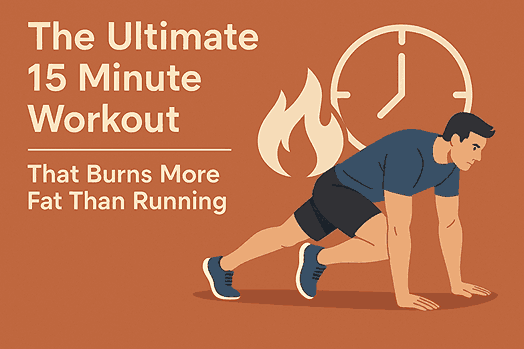
- Mountain Climbers: In a plank position, drive your knees toward your chest as fast as you can. Keep your core tight and your back straight.
- Jump Squats: Perform a regular squat, but as you come up, explode into a jump.4 Land softly and immediately lower into your next squat.
- High Knees: Run in place, driving your knees up toward your chest as high and as fast as you can. Use your arms to help you pump.
- Push-Ups: The classic. Modify by doing them on your knees if needed, but the goal is to keep your back straight and your core engaged.
Cool-Down (2 minutes):
- Hold a quad stretch for 30 seconds on each side.
- Hold a hamstring stretch for 30 seconds on each side.
Total Time: 15 minutes!
The “But I Can’t Do Burpees!” Myth
I hear you. Burpees are tough. The beauty of HIIT is its adaptability. The key principle is the work-to-rest ratio and the intensity. If a burpee is too much, you can modify it. Try a “squat thrust” (kick your feet back and in without the jump or push-up) or simply do a series of fast-paced jumping jacks.
The intensity is what matters. You should be breathing hard and feeling like you couldn’t do another rep by the end of your 30-second interval. If you’re not sweating, you’re not going hard enough.
HIIT isn’t a Magic Bullet, but it’s a Powerful Tool
It’s important to remember that a single 15-minute workout isn’t going to magically transform your body. For lasting results, you need to incorporate a few of these sessions into your weekly routine, ideally 3-4 times a week.
You also can’t out-train a bad diet. Nutrition plays a massive role in fat loss. While HIIT is incredibly effective, it’s most powerful when combined with a balanced diet rich in whole foods, lean proteins, and healthy fats.
The Mental Game: Why HIIT is Also a Confidence Booster
Beyond the physical benefits, there’s a powerful psychological advantage to HIIT. Completing a challenging workout in just 15 minutes gives you an incredible sense of accomplishment. It proves to you that you have the discipline and strength to push yourself, even when you’re short on time. That feeling of “I did it!” can spill over into other areas of your life, boosting your confidence and motivation.
Final Thoughts: Your Body, Your Rules
The goal of this article isn’t to say that running is bad. Running is a fantastic form of exercise with a ton of health benefits. But for those of us who are short on time, hate the monotony of steady-state cardio, or are looking for a new, powerful way to burn fat, HIIT is a phenomenal alternative.
So, the next time you feel like you don’t have enough time to work out, think again. Just 15 minutes is all you need to ignite your metabolism, torch fat, and build a stronger, fitter you. Give it a try. The results might just surprise you.